Why Richard Smallwoods’ ‘Total Praise’ Still Carries Us
I’m An Atheist. Why Richard Smallwoods’ ‘Total Praise’ Still Carries Me, And So Many Of Us
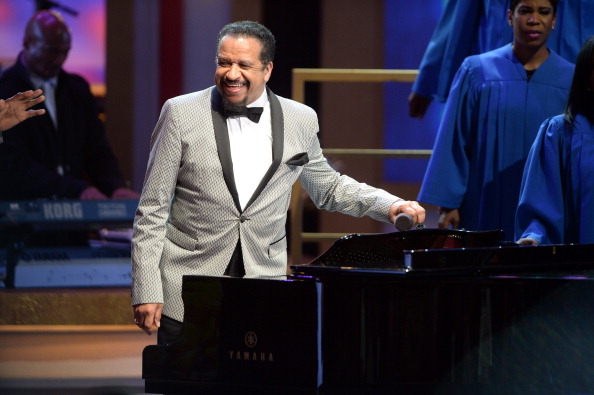
The gospel titan Richard Smallwood died Dec. 30, at the age of 77, from complications of kidney failure, and Black America responded the way it always does when a true architect of our inner lives leaves us.
We responded with sound.
Choirs leaned into his harmonies. Church musicians pulled his charts back out. Social media was filled with videos of sanctuaries trembling under familiar chords and compilations of HBCU marching bands stepping into formation as they rolled down streets, football fields, and across quads with their brass and drums carrying a song that was never meant to stay inside four church walls. The reaction made one thing unmistakably clear. This wasn’t just grief for a gospel composer who “went to glory.” This was a collective recognition of what a single song has done for us as a people.
I’m an atheist, and I listen to gospel music anyway — not because I’m confused about what I believe, but because Black gospel has never belonged only to belief. It belongs to survival. “Total Praise” has sat with me in moments when I didn’t have faith to lean on, only memory, muscle, and breath. It has steadied me when the world felt hostile and unrelenting. As a scholar of African-American history, that song has guided me as I’ve walked through America’s chamber of horrors. “Total Praise” has reminded me that I come from people who learned how to make something beautiful while standing under pressure. Richard Smallwood’s death makes me sad because he gave us a song that knew how to hold us without asking us to explain ourselves first. He gave us music that understood our weight, and stayed anyway. And I wonder quietly, if we will ever have another who knows how to do that so gently, so completely.
Smallwood wrote “Total Praise” in the mid-1990s, but its roots reach much deeper than its recording date. The song emerged from a period of intense personal strain in his life that was shaped by caregiving, illness, and uncertainty. Yet that context alone doesn’t explain why the song has traveled so far, or why it continues to gather people who do not share the same theology, politics, or even belief in a god. What explains its reach is that “Total Praise” does what Black music has always done at its highest level: it gives emotional structure to survival.
What gives “Total Praise” its staying power isn’t just how beautiful it sounds. It’s what the song does to us when life gets heavy. When words won’t come. When you don’t have the energy to explain your pain, or the faith to dress it up real nice. The song doesn’t rush you. Nor does it demand answers. It doesn’t ask you to figure anything out. It just gives you somewhere to stand when everything feels like it’s shifting under your feet. You can come to it tired. You can come to it confused. You can come to it holding more than you know how to carry, and it will hold you back.
Folks hear different meanings when they listen to “Total Praise.” In church, people hear devotion. They hear trust in a higher power. They hear surrender. Others hear the voices and hopes of our ancestors who survived worse than us. Some hear the memory of somebody who prayed for them through a hard season. Some remember the feeling of being held up when the world kept letting them fall. The song makes room for all of that. It sounds like Black life sounds with all its layers and complications stitched together from faith and fatigue, hope and heartbreak, belief and the sheer audacity to keep going.
And there’s something else the song protects, something we don’t talk about enough. In a country that is always watching Black pain, always filming it, arguing over it, consuming it, “Total Praise” gives us privacy. It lets us grieve without performing. It lets us worship without explaining.
Just listen to the song….
It builds slowly, like it knows we’re trying to catch our breath. The opening doesn’t rush in to save anybody. It starts almost spare, measured, and patient. Those first chords are laid down gently, as if the music is checking to see whether you’re ready. The melody doesn’t grab you by the collar. It walks beside you. The harmonies arrive soft, steady, giving you room to settle into the sound before asking anything of you. It feels like a gentle church mother’s hand placed on your back, not a shove forward.
The song opens with weariness, with eyes lifting not because the world is kind, but because staring straight ahead too long can undo you. The song understands that sometimes survival begins with re-orientation. With choosing where to look when the ground beneath you feels unsteady.
That opening gesture matters because Black life in America is marked by the repetition of crisis. Generation after generation has been asked to endure conditions that would be labeled national emergencies if they affected anyone else. From lynching to redlining to mass incarceration to medical neglect to state violence, the crises keep changing names while remaining structurally familiar. “Total Praise” does not try to resolve that reality. Instead, it offers a framework for holding it. The music keeps building slowly and deliberately. It invites breath before the volume. In a culture that demands Black performance even in grief, that restraint is itself radical.
Then, little by little, the song widens. Voices layer in, not all at once, but carefully until the room begins to fill. You can hear the lift before you feel it. The choir doesn’t explode, it gathers. Each line stacks on the one before it, building confidence the way Black folks do when we’re trying to stand back up after being knocked down. The music swells, but it never loses control. Even as the sound grows richer and fuller, it stays grounded like it knows shouting too soon won’t help.
When the song declares a “source of strength,” different listeners hear different things, and that flexibility is central to its power. For churchgoers, the source is a god. For others, the source is ancestral memory, communal care, or sheer stubborn will to live. For me, it’s a neurological experience that invites me to stay fully embodied. I can feel the way the song activates the part of the nervous system that tells your body it’s okay to soften, to stay present, to survive.
“Total Praise” does not collapse under that plurality. It accommodates it. That’s why atheists like me sing it. That’s why agnostics hum it under their breath during hard weeks. That’s why people who have long since left the church still know every rise and fall of its melody. The song doesn’t demand theological compliance. It meets people where they are emotionally and gives them somewhere to stand.
By the time the song reaches its peak, you’re already inside it. The repetition doesn’t feel excessive. It feels necessary. It feels like breathing in again because the first breath wasn’t enough. When the voices rise, when the chords stretch wider, it feels earned. You’ve been walked there. You’ve been carried there. And when the song finally opens up all the way, when it lets the sound pour out, it’s pure release. The kind that comes after holding your body tight for way too long.
And then, just as gently, it steadies again. The ending doesn’t slam the door. It settles, it affirms, and it leaves you standing, not shaken. It reminds us that not every response to suffering has to be loud to be holy. Sometimes survival looks like quiet and sometimes faith looks like stillness. Sometimes strength sounds like a song that knows how to wait with you, how to move only when you’re ready, and how to leave you standing a little taller than when you walked in.
This is also why “Total Praise” translates so powerfully outside of church spaces, particularly into HBCU band culture. Black colleges and universities have always functioned as more than educational institutions. They are cultural fortresses built in response to exclusion, places where Black excellence is normalized rather than exceptionalized. When marching bands adapt “Total Praise,” they expand it and demonstrate that the song belongs to Black life in its fullness, including our discipline, our artistry, our joy, and our collective pride. Brass instruments carry the melody forward, percussion adds urgency, and the song becomes a moving body, not just a sung one. It becomes praise with proud and audacious posture.
That matters because Black Americans have always had to negotiate public space carefully. Our bodies are constantly read, policed, and misinterpreted. Music has long been one of the few arenas where we can occupy space loudly without apology. “Total Praise,” when played by a band, claims that right. It asserts that reverence and power are not opposites, that gentleness does not mean weakness, and that discipline and emotion can coexist without canceling each other out.
“Total Praise” can be heard at funerals, graduations, protests, rehearsals, and moments of private breaking because it still does work. It helps Black people remain human in conditions that are intentionally designed to grind that humanity down. In that sense, the song is not a relic of Black religious life, but a living response to a racist present. It is a song that expresses how survival is not only resistance, but restoration.
The song’s longevity also lies in its refusal to be trendy. Smallwood’s compositional style drew heavily on classical training, choral tradition, and harmonic complexity. He was never chasing the moment. He was building something meant to last. That architectural quality allows “Total Praise” to age without feeling dated. And this is why each generation can find itself inside it anew. The song is a bridge across time, connecting different eras of Black struggle and endurance.
What I love most about “Total Praise” is that it does not beg for justice. It assumes the singer deserves to survive long enough to demand it. Too often, Black suffering is consumed publicly without respect for Black interior life. But “Total Praise” protects that interiority, and it insists that there is a private realm of feeling that does not exist for public consumption.
Smallwood’s passing has made that truth newly visible. The tributes pouring in are not only about him as an individual, but about what he helped Black America articulate. He gave us a song that functions as a collective exhale. A musical place where belief and disbelief, grief and gratitude, exhaustion and hope can sit in the same room without fighting. That is no small gift in a nation that thrives on forcing false binaries onto Black people.
What “Total Praise” has done for us, ultimately, is remind us that survival is not only about resistance. It is also about restoration. About finding ways to tend to the soul, however one defines it, in a world that profits from our depletion. The song doesn’t solve racism. It doesn’t stop violence. It doesn’t erase loss. But it helps us remain human in the face of those forces. It helps us remember that we are more than what we endure.
SEE ALSO:
Throwback Gospel Performances We’ll Never Forget
Quincy Jones’ Gospel Music Legacy
I’m An Atheist. Why Richard Smallwoods’ ‘Total Praise’ Still Carries Me, And So Many Of Us was originally published on newsone.com


